1. The Clock Strikes Seven
Of all the problems which have been submitted to my friend, Mr. Sherlock Holmes, for solution during the years of our intimacy, there were only two which I was the means of introducing to his notice, one of which was that of Mr. Hatherley’s thumb.
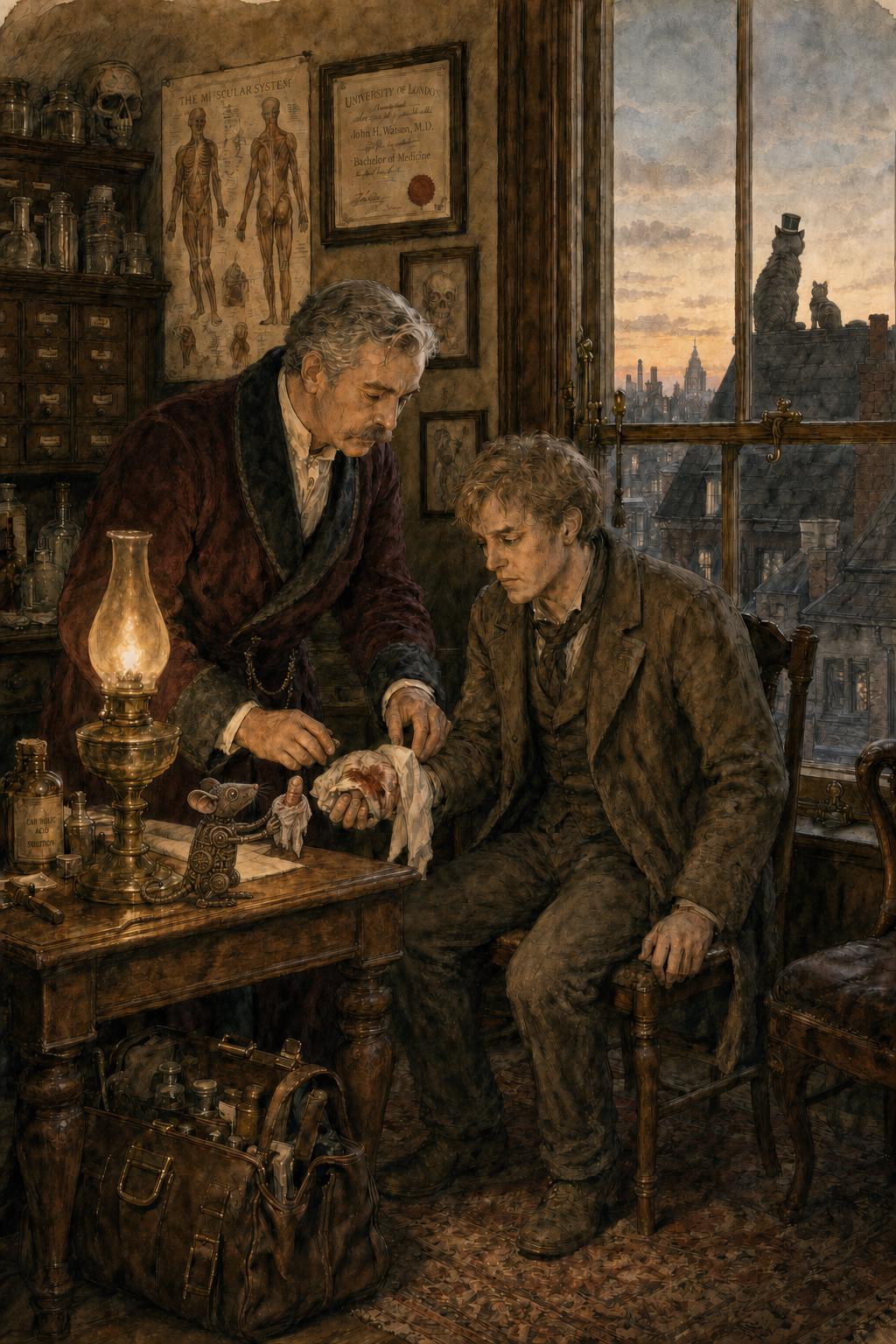
One morning, at a little before seven o’clock, I entered my consulting-room and found a gentleman seated by the table. His card read “Mr. Victor Hatherley, hydraulic and clockwork engineer". He was accompanied by a smartly assembled young mouse who proffered up to me what looked to all the world like a human thumb!
“A very good morning to you, Doctor. My name is Victor Hatherley and this is my friend," said the young gentleman, gesturing with his uninjured hand to the small mouse, "Tick-Tock. I am sorry to knock you up so early, but I have had a very serious accident during the night."
He unwound the handkerchief and held out his hand. It gave even my hardened nerves a shudder to look at it. There were four protruding fingers and a horrid red, spongy surface where the thumb should have been. It had been hacked or torn right out from the roots.
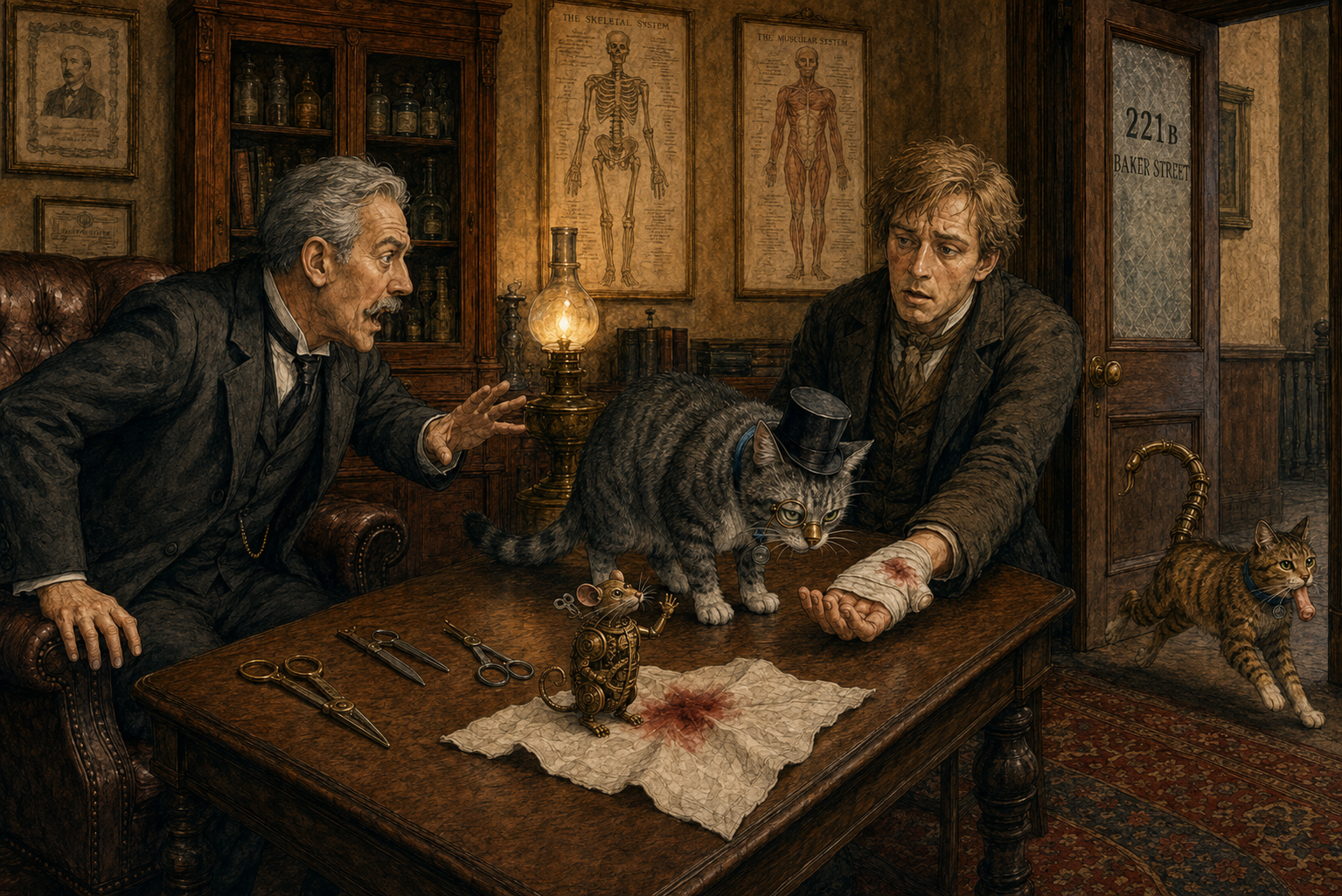
I was just considering if it was worth attempting to reattach the existing thumb Tick-Tock was still offering to me or simply to upgrade it when Mrs. Hudson’s cats, Catticus Finch and Lollipop sauntered in through the open, consulting-room door and made the decision for me.
The two cats were built to address the plague of rats that had ever been the curse of Old London Town. Every establishment with the means to afford one had a steamborg, these days. Usually a cat or dog adapted to the work. To Mrs. Hudson’s ever-lasting pride these murine predators were most efficient at their job. A rat had not been seen in Baker Street for many a moon. No doubt it was Tick-Tock’s presence that had prompted them to enter, their implants already activating, and I worried that my new patient would lose his diminutive companion to these efficient exterminators.
It seemed, however, rather than his person it was what he was holding that fascinated Lollipop, the smaller (and I secretly suspected, deadlier) of the two and quicker than lighting she leapt over the table, snatched Hatherley’s thumb from the paws of his miniscule friend and ran with it, held in her jaws out of the consulting room!
In the commotion, her companion had silently jumped onto the table and was intent on burying his nose, now a shining brass array of olfactory sensors, into the makeshift bandages of Mr. Hatherley’s injured hand.
"I fear we shan’t see that old thumb of yours again!" I said to Hatherley in a consoling voice, reaching for my box of "Tom’s Thumbs. "Not to worry, we’ll soon have you fixed up, good as new … better than new, if I can be a judge."
"Good Heavens, I’m all thumbs today!" - This last, I said to myself as I had dropped my surgical screwdriver making a long arm to the box on the shelf and bringing it to the table.
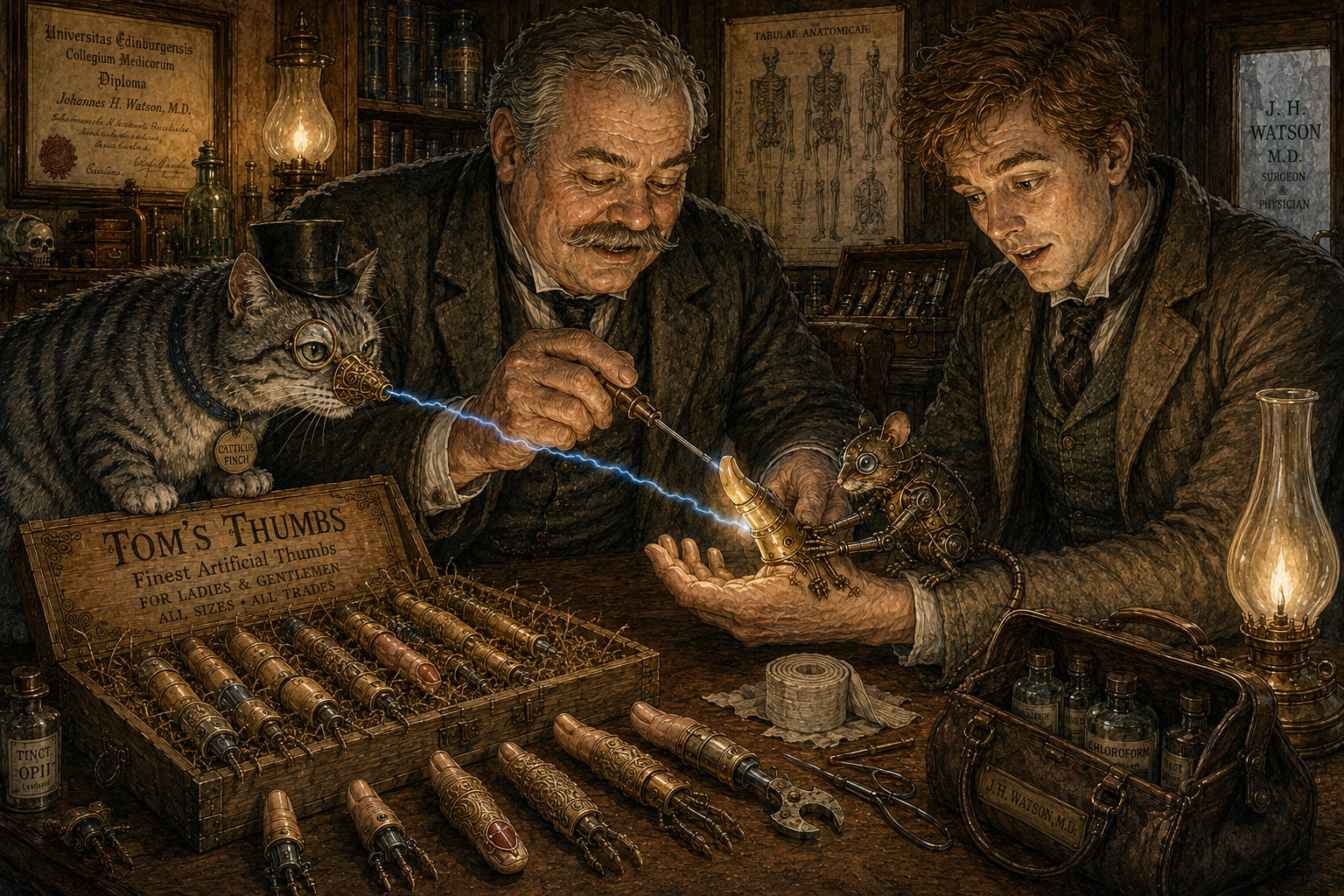
I often think to myself that these newfangled implants and attachments have reduced the men of my profession to mere mechanics although I cannot but marvel at the continuing advancements in this scientific age. Take Hatherley’s thumb for instance. He selected a fairly modest model from the box of "Tom’s Thumbs" and I placed it on top of the open wound, where the original had once lived. I needed to give it a quick jolt of electricity to activate it and little Tick-Tock, the helpful fellow sprang onto Hatherley’s wrist and steadied the new thumb whilst I reached for my surgical screwdriver. However, before I had even raised it, Catticus Finch who had been watching with rapt attention and courses with as much electricity as he does sanguine fluid, took it upon himself to provide the necessary stimulus though an even more extended olfactory array than before. There was little for me to do, after that. Once the thumb was live, so to speak it administered an anaesthetic load as it’s bone anchors screwed their way down into what was left of Hatherley’s socket, the nerve connectors sort out his median, radial and ulnar nerves, splicing themselves to the severed ends and the flesh-hooks snaked over the surface of his hand to further secure his new appendage, in place. After a minute the whole procedure was complete and Hatherley, in quiet amazement found he could pick up his pencil or one of my instruments quite as dexterously as he had before his terrible accident, I presumed.
"By no means," said Mr. Hatherley when I asked him what mishap had lost him his thumb. "It was a murderous attack. I shall have to tell my tale to the police; but, between ourselves, if it were not for the convincing evidence of this wound of mine, I should be surprised if they believed my statement, for it is a very extraordinary one, and I have not much in the way of proof with which to back it up; and, even if they believe me, the clues which I can give them are so vague that it is a question whether justice will be done."
"You must tell this to my friend, Mr. Sherlock Holmes," I said at last, "before you go to the police. We’ll call a cab and go together. We shall just be in time to have a little breakfast with him."
2. Breakfast at Baker Street
I called a cab and we were quickly at Baker Street. Sherlock Holmes was, as I expected, lounging about his sitting-room in his dressing-gown, reading the agony column of The Times and smoking his before-breakfast pipe. He received us in his quietly genial fashion, ordered fresh rashers and eggs, and joined us in a hearty meal.
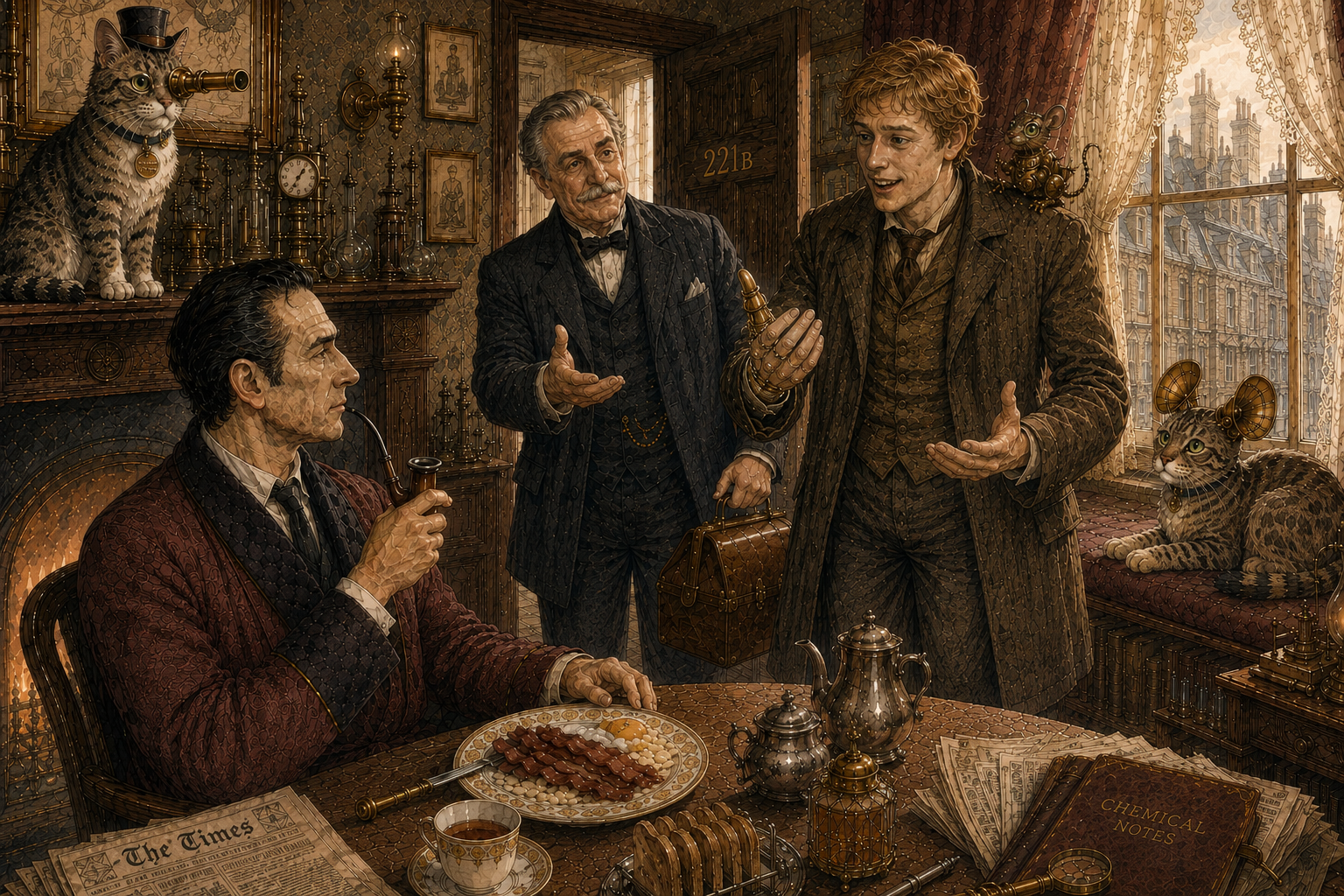
“It is easy to see that your experience has been no common one, Mr. Hatherley,” said he. “Pray, lie down there and make yourself absolutely at home. Tell us what you can, but stop when you are tired and keep up your strength with a little stimulant.”
“Thank you,” said my patient, “but I have felt another man since the doctor replaced my thumb, and I think that your breakfast has completed the cure. I shall take up as little of your valuable time as possible, so I shall start at once upon my peculiar experiences.”
Holmes sat with the weary, heavy-lidded expression which veiled his keen and eager nature, while I sat opposite to him, and we listened in silence to the strange story which our visitor detailed to us.
3. The Mysterious Colonel
“You must know,” said he, “that I am an orphan and a bachelor, residing alone in lodgings in London. By profession I am a hydraulic engineer but I have been making clock-work mice since I was a boy. I have had considerable experience of my work during the seven years that I was apprenticed to Venner & Matheson, the well-known firm, of Greenwich. Two years ago, having served my time, and having also come into a fair sum of money through my poor father’s death, I determined to start in business for myself and took professional chambers in Victoria Street.
“I suppose that everyone finds his first independent start in business a dreary experience. To me it has been exceptionally so. During two years I have had three consultations and one small job, and that is absolutely all that my profession has brought me. My gross takings amount to £ 27 10s. Every day, from nine in the morning until four in the afternoon, I waited in my little den, until at last my heart began to sink, and I came to believe that I should never have any practice at all.
“Yesterday, however, just as I was thinking of leaving the office, my clerk entered to say there was a gentleman waiting who wished to see me upon business. He brought up a card, too, with the name of ‘Colonel Lysander Stark’ engraved upon it. Close at his heels came the colonel himself, a man rather over the middle size, but of an exceeding thinness. I do not think that I have ever seen so thin a man. His whole face sharpened away into nose and chin, and the skin of his cheeks was drawn quite tense over his outstanding bones. Yet this emaciation seemed to be his natural habit, and due to no disease, for his eye was bright, his step brisk, and his bearing assured. He was plainly but neatly dressed, and his age, I should judge, would be nearer forty than thirty.
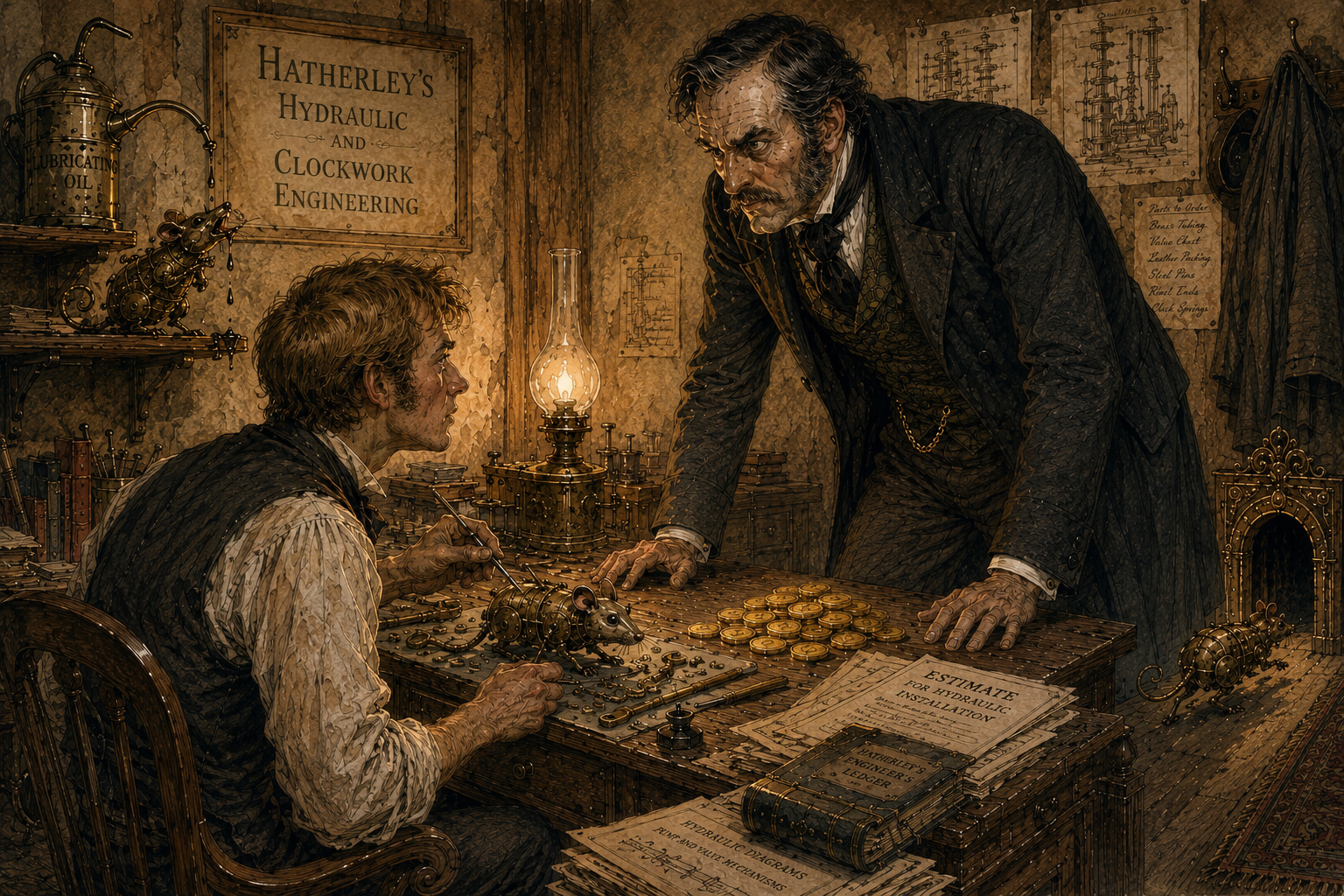
"Mr. Hatherley?" said he, with something of a German accent. "You have been recommended to me, Mr. Hatherley, as being a man who is not only proficient in his profession but is also discreet and capable of preserving a secret. I have a professional commission for you, but absolute secrecy is quite essential — absolute secrecy, you understand."
"If I promise to keep a secret," said I, "you may absolutely depend upon my doing so."
He looked very hard at me as I spoke, and it seemed to me that I had never seen such a suspicious and questioning eye.
"Absolute and complete silence before, during, and after? No reference to the matter at all, either in word or writing?"
"I have already given you my word." I said sternly but in truth a feeling of repulsion, and of something akin to fear had begun to rise within me at the strange antics of this fleshless man.
"How would fifty guineas for a night’s work suit you?" he asked. "I say a night’s work, but an hour’s would be nearer the mark. I simply want your opinion about a hydraulic stamping machine which has got out of gear. If you show us what is wrong, we shall soon set it right ourselves. What do you think of such a commission as that?"
"The work appears to be light and the pay munificent," I said.
"Precisely so," he replied. "We shall want you to come to-night by the last train, to Eyford, in Berkshire. It is a little place near the borders of Oxfordshire, and within seven miles of Reading. There is a train from Paddington which would bring you there at about 11:15. I shall come down in a carriage to meet you. Our little place is quite out in the country. It is a good seven miles from Eyford Station."
"Let me explain. You are probably aware that fuller’s-earth is a valuable product, and that it is only found in one or two places in England? Some little time ago I bought a small place within ten miles of Reading. I was fortunate enough to discover that there was a deposit of fuller’s-earth in one of my fields. On examining it, however, I found that this deposit was a comparatively small one, and that it formed a link between two very much larger ones upon the right and left — both of them, however, in the grounds of my neighbours. These good people were absolutely ignorant that their land contained that which was quite as valuable as a gold-mine. Naturally, it was to my interest to buy their land before they discovered its true value, but unfortunately, I had no capital by which I could do this. I took a few of my friends into the secret, however, and they suggested that we should quietly and secretly work our own little deposit and that in this way we should earn the money which would enable us to buy the neighbouring fields. This we have now been doing for some time, and in order to help us in our operations, we erected a hydraulic press. This press, as I have already explained, has got out of order, and we wish your advice upon the subject. We guard our secret very jealously, however, and if it once became known that we had hydraulic engineers coming to our little house, it would soon rouse inquiry, and then, if the facts came out, it would be goodbye to any chance of getting these fields and carrying out our plans. That is why I have made you promise me that you will not tell a human being that you are going to Eyford to-night. I hope that I make it all plain?"
"I quite follow you," said I. "The only point which I could not quite understand was what use you could make of a hydraulic press in excavating fuller’s-earth, which, as I understand, is dug out like gravel from a pit."
"Ah!" said he carelessly, "we have our own process. We compress the earth into bricks, so as to remove them without revealing what they are. But that is a mere detail. I have taken you fully into my confidence now, Mr. Hatherley, and I have shown you how I trust you." He rose as he spoke. "I shall expect you, then, at Eyford at 11:15."
"I shall certainly be there."
"And not a word to a soul." He looked at me with a last long, questioning gaze, and then, pressing my hand in a cold, dank grasp, he hurried from the room.
4. Spread 5 — The Night Train
Pages 14–15 — Double-page spread
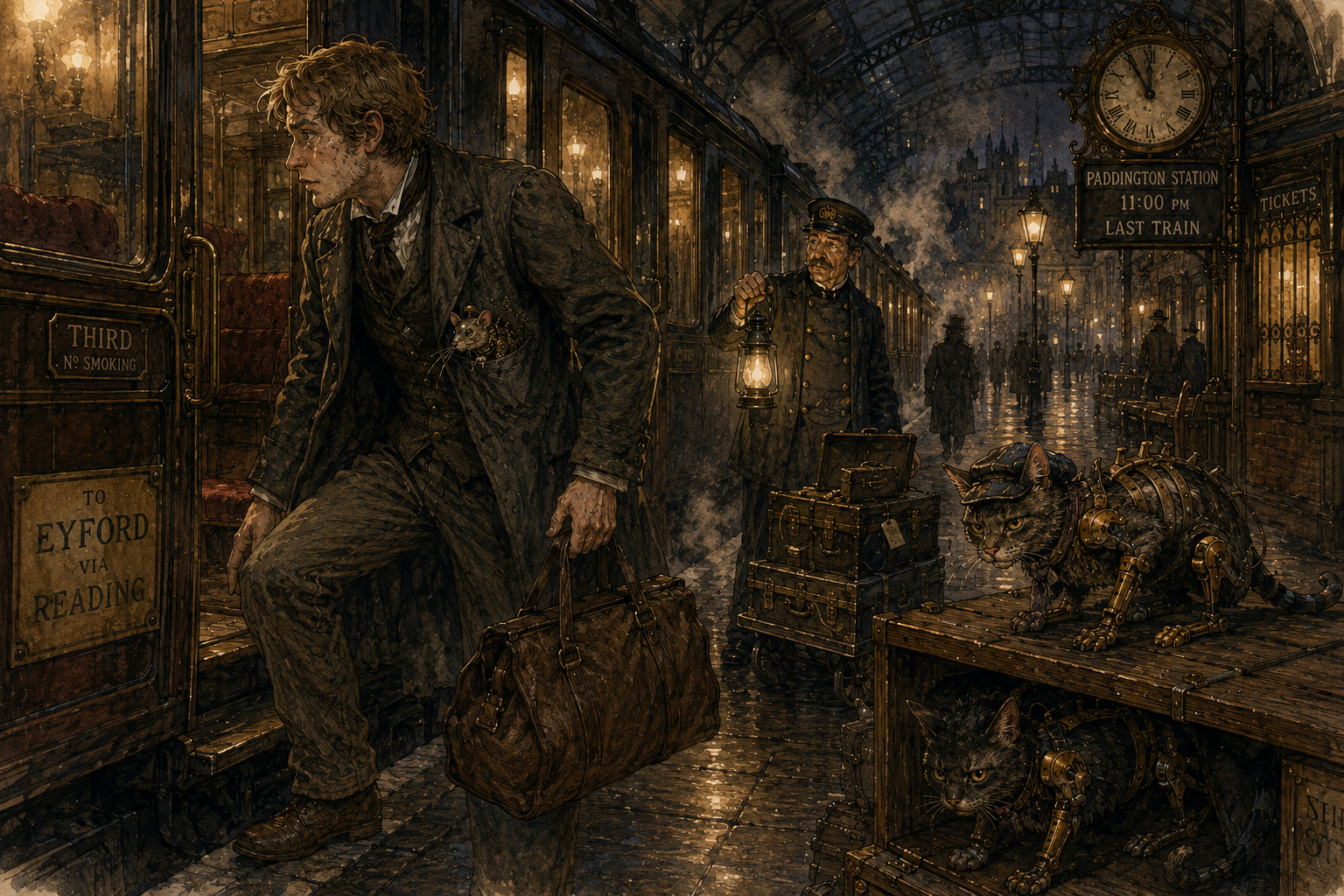
Scene: Paddington Station at night. Steam hisses around the platform lamps. Hatherley boards the last train to Eyford, a small Berkshire village.
Narration:
At eleven o’clock that night, he took the last train from Paddington. At Reading he changed, and at Eyford, a sleepy porter with a lantern watched the sole passenger alight.
In the shadows beyond the wicket, a carriage waited.
Cat note: Catticus and Lollipop are not present but there are a couple of feral steamborg cats on the platform eyeing Hatherley and the mouse slyly and sinisterly. Feral steambord cats can be paralleled with the street urchins making up Sherlock Holmes "irregulars". One may have a worn out cap. They can’t hide their steampunk modifications so there should be tarnished brass fittings clearly visible. Likely legs and spine replacements.
Mouse Note: Tick-tock, the hydro-clockwork mouse is sticking it’s head out of Hatherley’s coat pocket (surreptitiously).
5. Spread 6 — The Frosted Windows
Pages 16–17 — Double-page spread
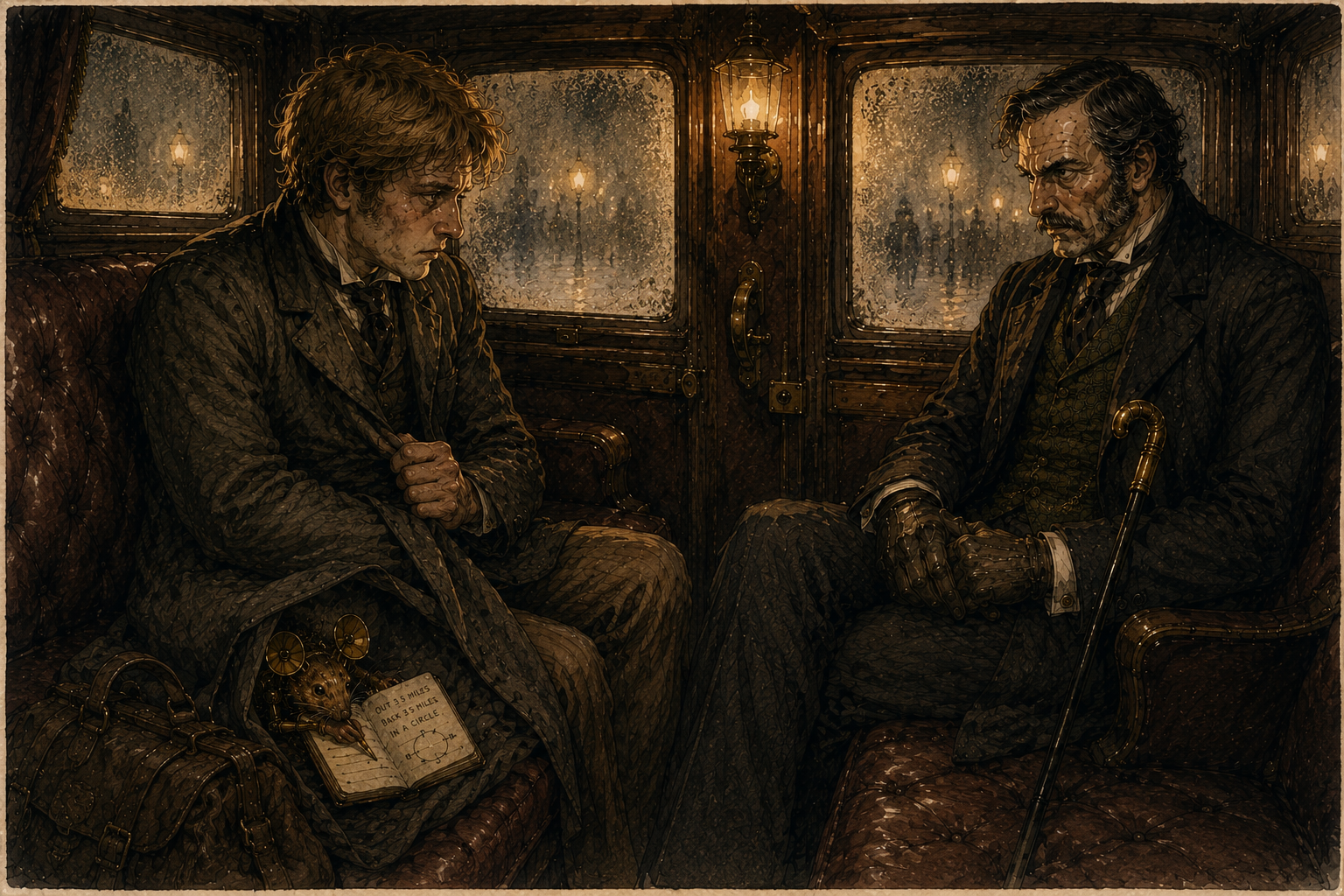
Scene: Hatherley has arrived at Eyford where Colonel Stark picks him up from the station, in his carriage. Inside the carriage. Hatherley sits opposite Colonel Stark. The windows are frosted — he can see nothing of the route. The colonel watches him in silence.
Narration:
The carriage windows were made of frosted glass. Hatherley could see nothing but the occasional blur of a passing light. The colonel sat in silence, watching.
The drive took an hour. Seven miles, Stark had said. It felt like twelve.
Cat Note: There are no cats in this scene
Mouse note: Hatherley’s hydro-clockwork mouse’s ears have transformed into little radar dishes and are scanning from side to side. The mouse makes little notes as to where they are going (out six miles, back six miles, in a circle) in a tiny notebook with a tiny pencil. The mouse does this surreptitiously, out of sight of the Colonel
6. Spread 7 — The House in the Country
Pages 18–19 — Double-page spread
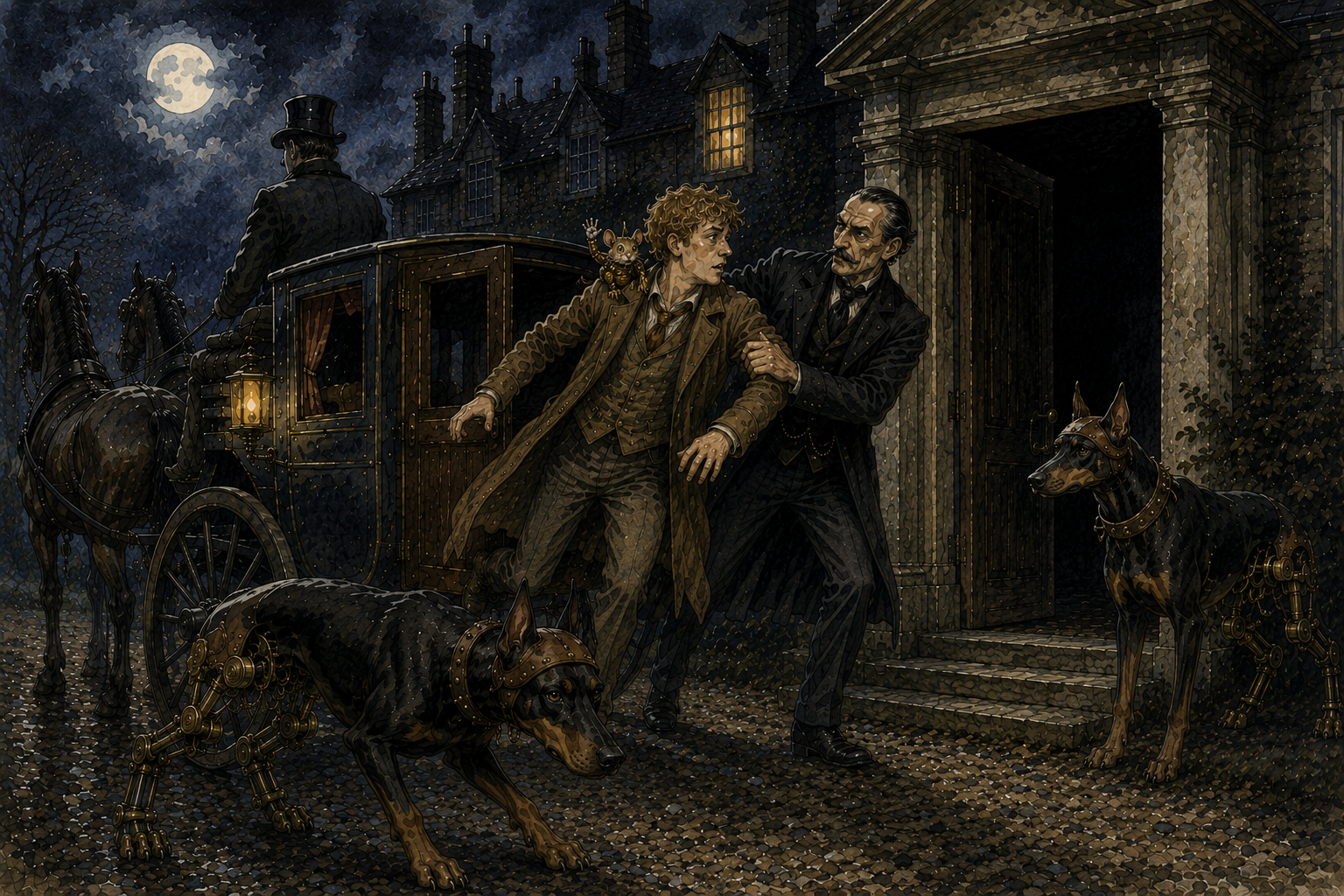
Scene: A large, rambling country house. The carriage pulls up to a porch. Hatherley is hurried inside before he can glimpse the front. The door slams. Inside, darkness — then a woman appears with a lamp, her face frightened.
Narration:
The instant he crossed the threshold, the door slammed behind him. A woman appeared with a lamp, her face beautiful but sick with fear.
"I would go," she whispered. "There is no good for you to do."
Hatherley, thinking only of his fee, refused.
Cat note: Outside, some rough looking steamborg dogs prowl the perimeter. They have enhanced legs, studded collars and wear leather caps on their heads.
Mouse Note: Tick-tock is back in Hatherley’s pocket, and is waving at one of the dogs in a friendly fashion, again!
7. Spread 8 — The Hydraulic Press
Pages 20–21 — Double-page spread
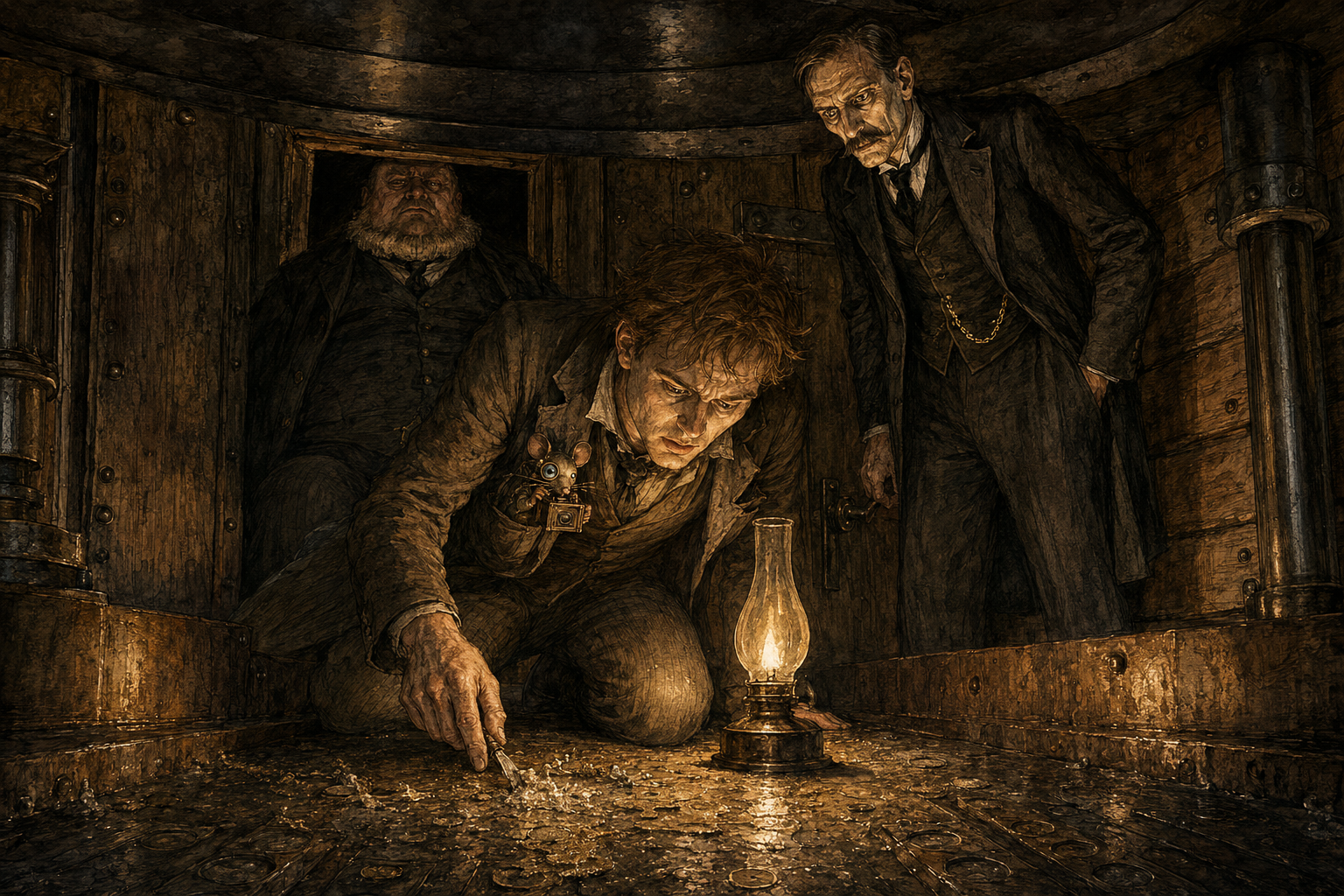
Scene: A small, square chamber inside the press. Hatherley stands with Stark and the fat manager, Ferguson. The ceiling is the underside of a massive piston. Hatherley’s lamp illuminates a metal floor crusted with metallic deposit.
Narration:
"This is the hydraulic press," said Stark. He watched Hatherley examine the mechanism.
Hatherley saw at once the truth: the story of fuller’s-earth was a lie. This was a coining press — a counterfeit operation. He had been tricked.
Cat note: No cats are present in this scene
Mouse Note: Tick-tock, now back in Hatherley’s top pocket takes a picture, like a tourist, with a small camera of the coining press
8. Spread 9 — Trapped
Pages 22–23 — Double-page spread
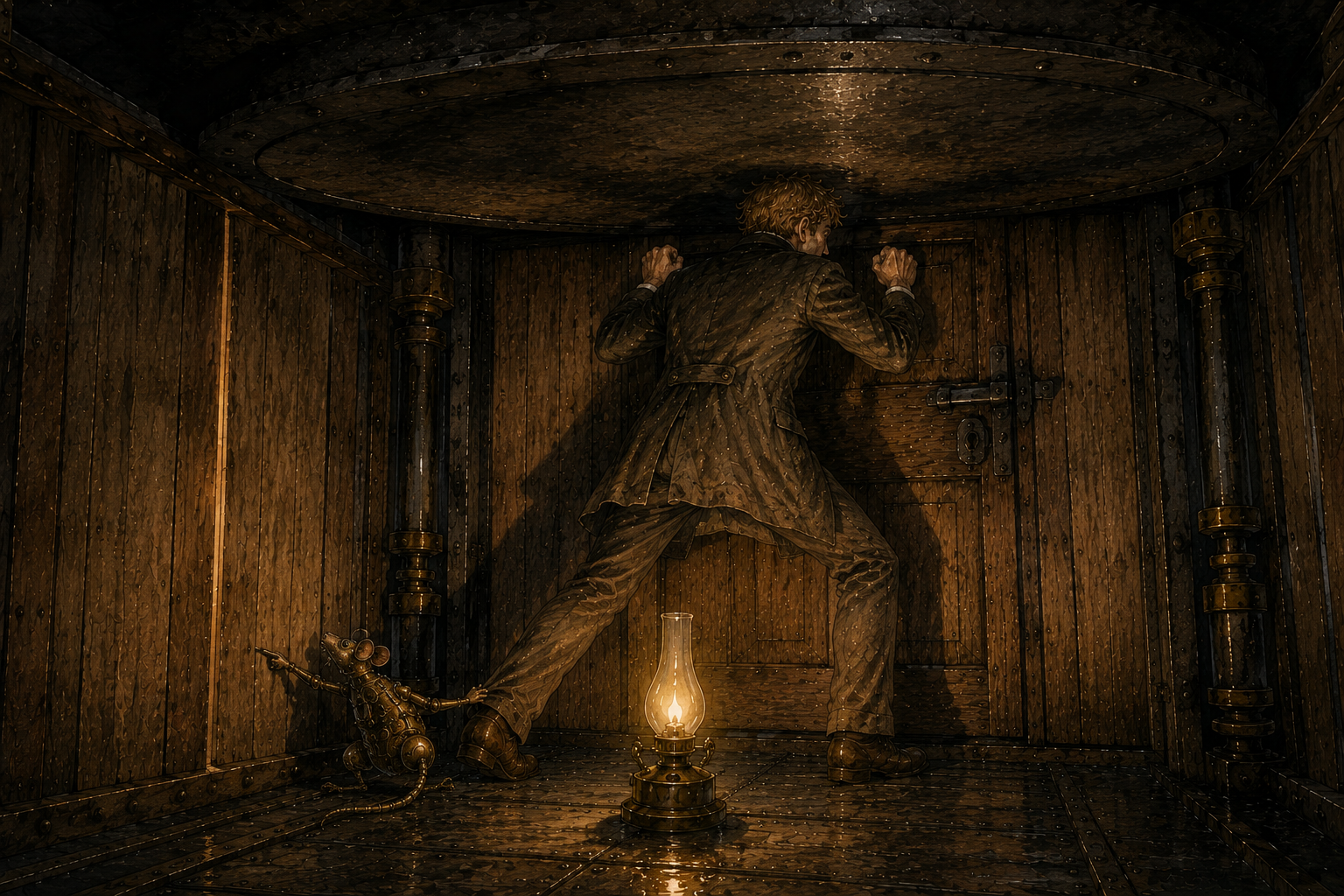
Scene: The door slams shut. Hatherley hammers against it. Above him, the black ceiling begins to descend — slowly, jerkily, with terrible force.
Narration:
"You shall know all about the machine," Stark snarled — and slammed the door. The key turned. The levers clanked.
The ceiling began to descend. One foot. Two feet. Hatherley could not stand upright.
Cat note: No cats are present in the scene
Mouse note: Tick-tock has left Hatherley’s coat and has run around the chamber and found the secret panel and is pointing helpfully. Unfortunately, Hatherley’s attention is all on the slammed door and descending ceiling as he doesn’t immediately see what tick-tock has found.
9. Spread 10 — The Secret Panel
Pages 24–25 — Double-page spread
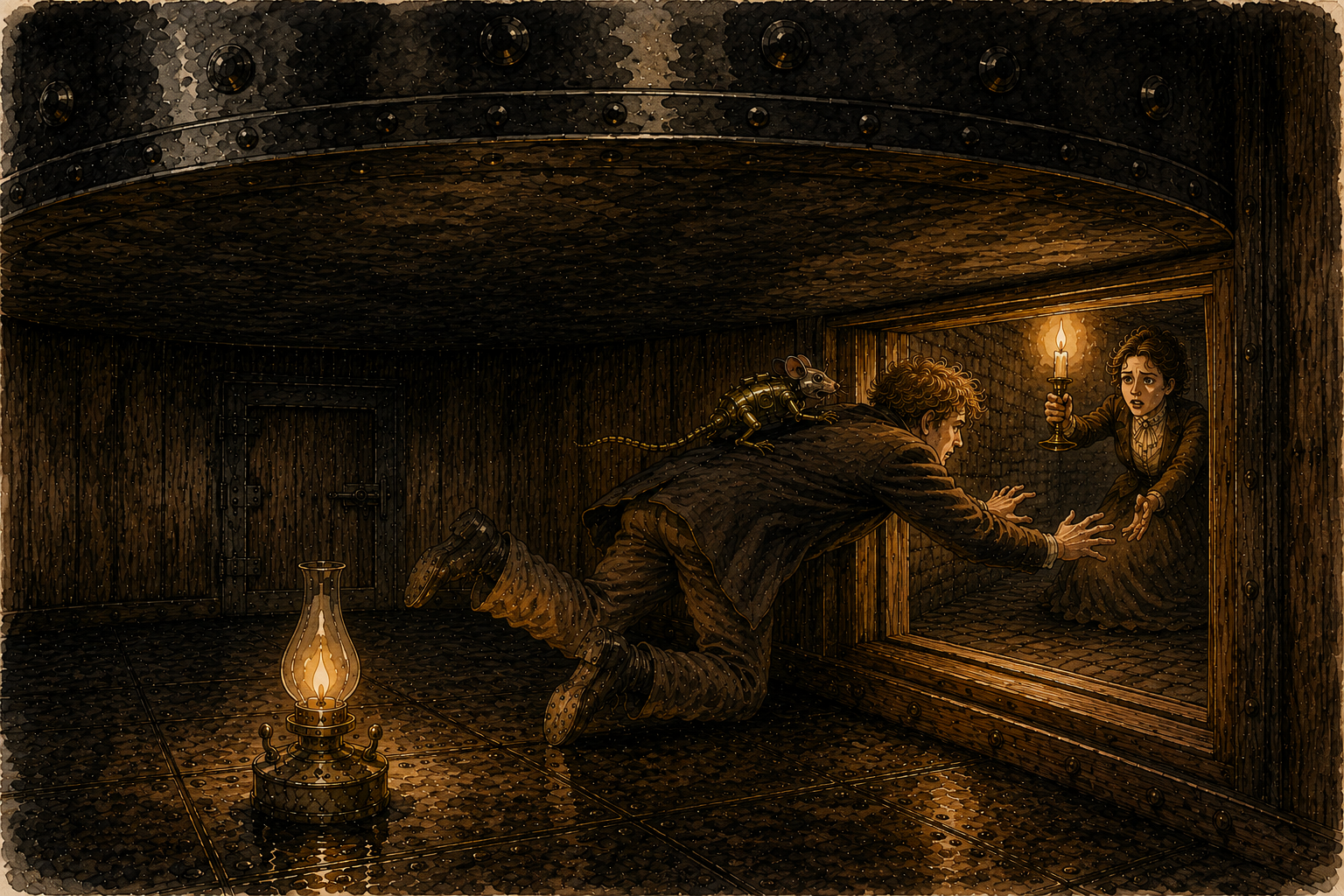
Scene: A thin line of yellow light appears between the wooden wall panels. They slide open — the woman from before, candle in hand. Hatherley is midway through the opening, his head and torso already in the passage, his legs still in the press chamber — he is launching himself through, hands extended toward her, away from the descending piston behind him. Tick-Tock surfs on his back. Behind him, the lamp sits intact on the metal floor; the flat black piston ceiling descends above it. The press closes with a crunch of metal on metal.
Narration:
A thin line of yellow light split the darkness — a hidden panel, opened by the woman. Hatherley threw himself through, his body crossing the threshold as the press clanged shut behind him.
"Come!" she cried. "They will be here in a moment!"
Cat note: no cats in this scene
Mouse Note: Tick-tock rides Hatherley like a surf board as Hatherley throws himself through the secret panel, past the woman
10. Spread 11 — The Cleaver
Pages 26–27 — Double-page spread
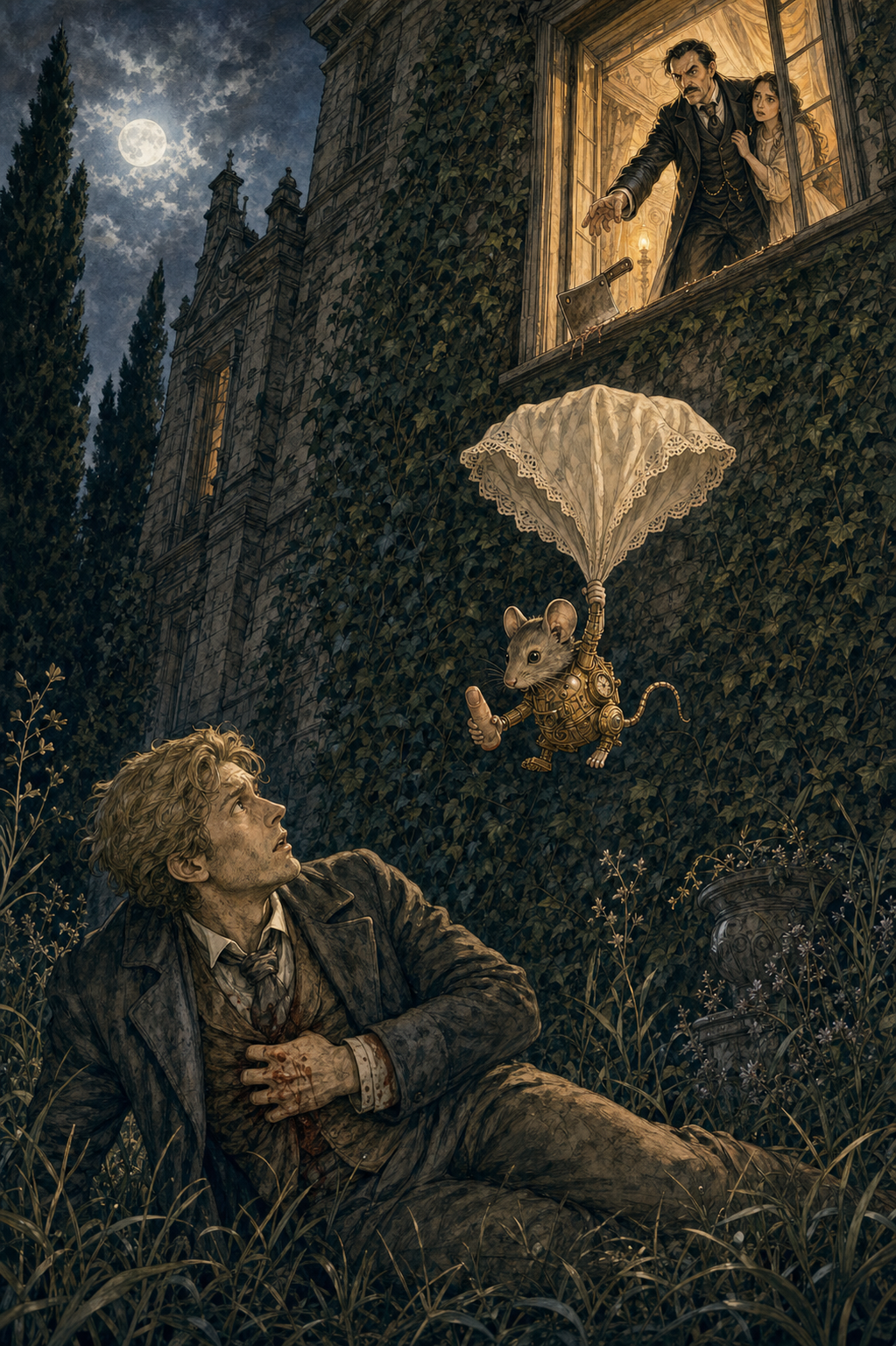
Scene: The moonlit bedroom. The woman holds Stark back as Hatherley clambers out the window. The colonel breaks free, raises a butcher’s cleaver, and brings it down. Hatherley falls.
Narration:
The woman threw her arms around the colonel, crying, "He will be silent!" He dashed her aside and swung the cleaver.
Hatherley let himself drop. The blade caught his thumb — hacked it clean off. He fell into the garden below, unconscious.
Cat note: No cats in this scene
Mouse Note: Hatherley has fallen to the ground, clutching his injured hand. Tick-tock had snatched Hatherley’s thumb from where it rested beside the clever and using Hatherley’s handkerchief as a parachute, the four corners of which he is holding in his other hand, floats down, safely to join Hatherley on the ground.
11. Spread 12 — Morning at Eyford
Pages 28–29 — Double-page spread
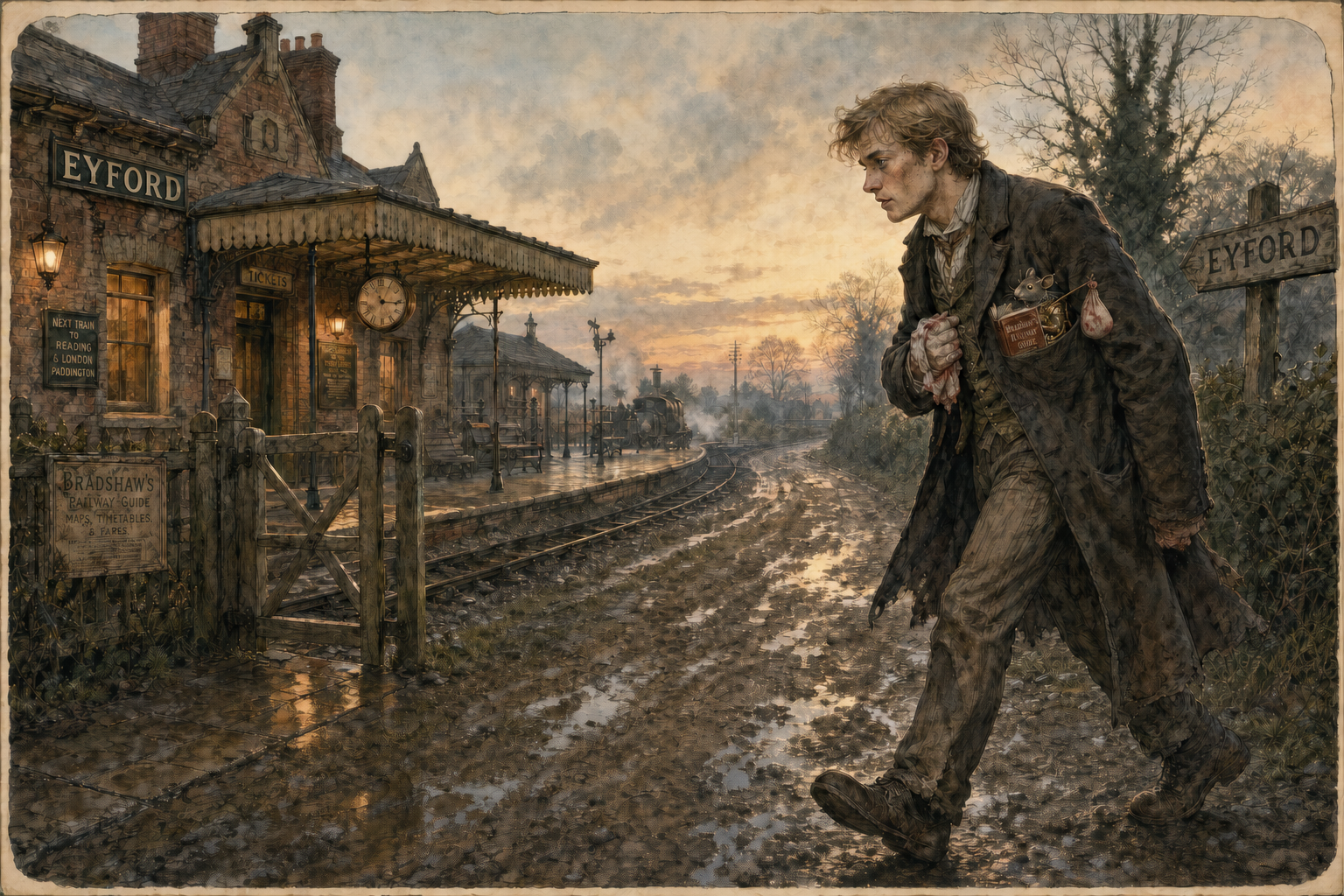
Scene: Dawn. Hatherley wakes in a hedge by the roadside, hand throbbing. He staggers to the railway station — it is the very station where he arrived.
Narration:
When he awoke, the moon had sunk and a bright morning was breaking. He was lying in a hedge by the high road. Neither house nor garden were to be seen.
Staggering to the station, he took the first train back to London.
Cat Note: There are no cats in this scene.
Mouse Note: Tick-Tock has used the parachute handkerchief to wrap up Hatherley’s thumb into a red-stained bundle which he has suspended on a small twig-like stick and carries over his shoulder like a hobo. He has scrambled back into Hatherley’s top pocket and in his other hand is consulting a mouse-sized version of Bradshaw’s railway guide to find the next train back to London.
12. Spread 13 — Six Miles Out and Six Miles Back
Pages 30–31 — Double-page spread
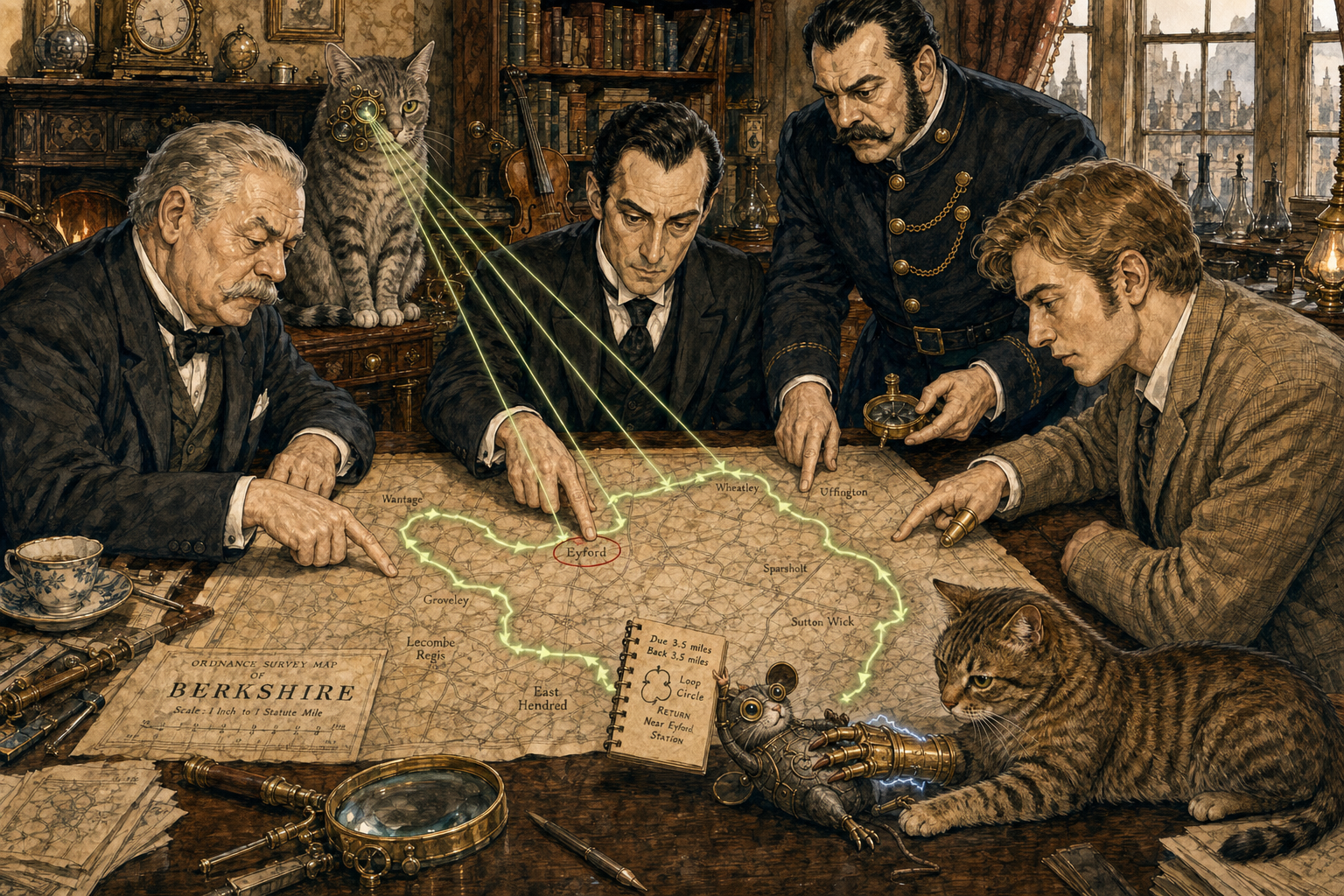
Scene: Back at 221B Baker Street. The ordnance map is spread on the table in Holmes' sitting room. Holmes, Hatherley, Watson, and Bradstreet argue over the compass directions. Holmes calmly places his finger in the centre of the circle Bradstreet has drawn.
Narration:
"I think I could lay my finger on it," said Holmes quietly.
"Really, now!" cried the inspector. "You have formed your opinion! Come, now, we shall see who agrees with you. I say it is south, for the country is more deserted there."
"And I say east," said my patient.
"And I am for north," said I.
"You are all wrong."
"But we can’t all be."
"Oh, yes, you can. This is my point." He placed his finger in the centre of the circle. "This is where we shall find them."
"But the twelve-mile drive?" gasped Hatherley.
"Six out and six back. Nothing simpler. You say yourself that the horse was fresh and glossy when you got in. How could it be if it had gone twelve miles over heavy roads?"
Mouse Note: Tick-Tock frantically waves the notes he took in the original carriage ride. His heightened steamborg senses recorded the circuitous route — out six miles, back six miles, in a circle — but none of the humans pay him any attention.
Cat note: The cats notice Tick-Tock’s gestures immediately. Lollipop pins him down with one paw that has transformed into a steampunk paw — long copper claws, fizzing with electricity. Catticus’s monocled eye becomes more elaborate and projects a cone-shaped green laser pattern of Tick-Tock’s drawing as an overlay to the map, so that Holmes can clearly see that the carriage drove a circuitous route out of Eyford and then back into it, to the house which was barely a quarter of a mile from the station.
13. Spread 14 — The Investigation Party Departs
Pages 32–33 — Double-page spread
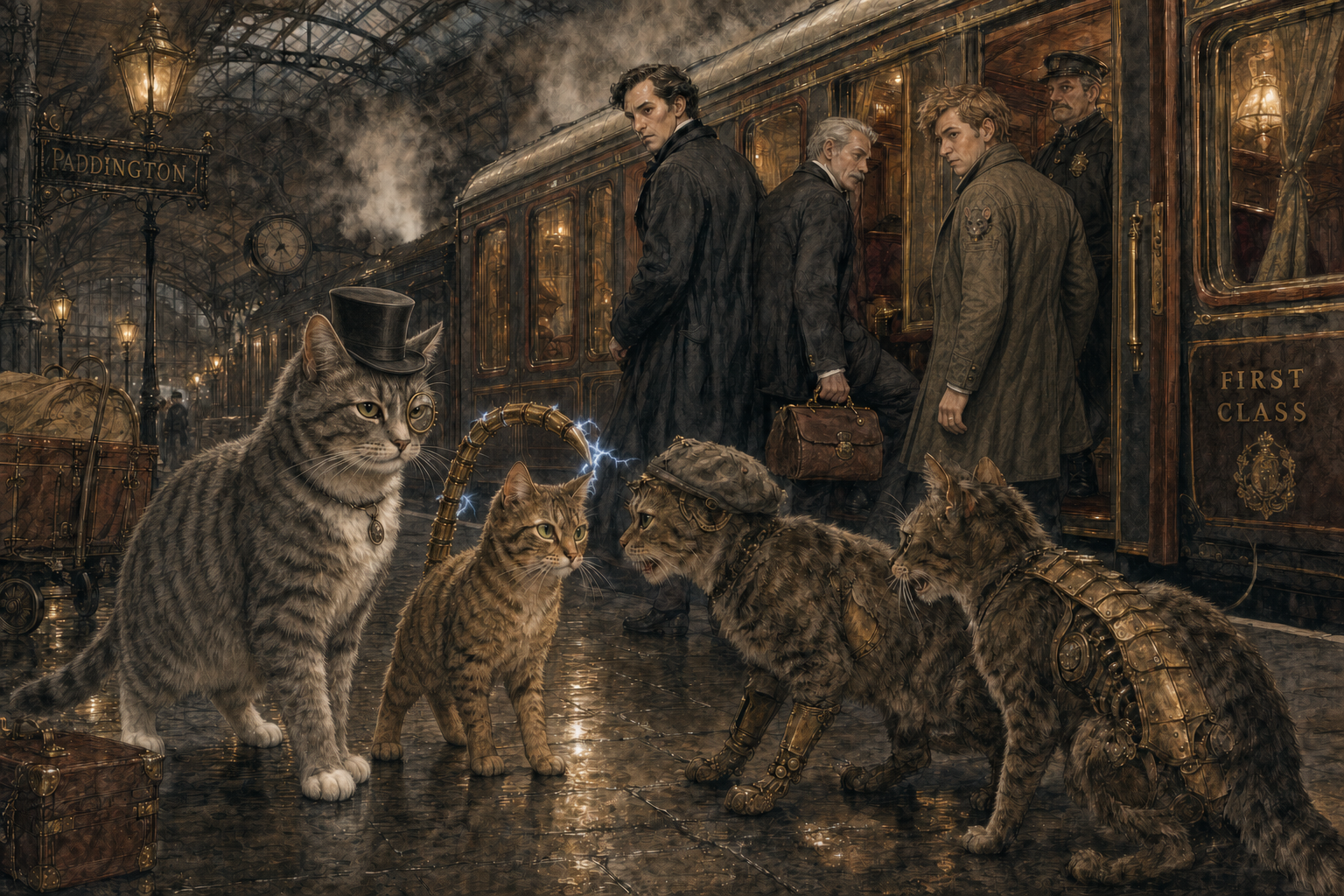
Scene: Paddington Station. The train compartment, bound from Reading to Eyford. Holmes, Hatherley, Watson, and Inspector Bradstreet are climbing into a first-class carriage. Tick-Tock is back in Hatherley’s top pocket.
On the platform, two feral steamborg cats watch the party board — tarnished brass leg replacements, a worn spine plate, one with a battered cap. Catticus and lollipop are cautiously approaching the feral cats and it looks like they might be exchanging information.
Narration:
Some three hours or so afterwards we were all boarded the train together, bound from Reading to the little Berkshire village. There were Sherlock Holmes, the hydraulic engineer, Inspector Bradstreet, of Scotland Yard, and myself.
Cat note: Catticus and Lollipop approach the two feral cats from the "night train" scene and it looks like the feral cats have information to divulge about the last time they saw Hatherley.
Mouse Note: Tick-Tock is back in Hatherley’s top pocket after his morning adventure. He peers out surreptitiously, his natural rounded mouse ears visible.
14. Spread 15 — The Coiners Exposed
Pages 34–35 — Double-page spread
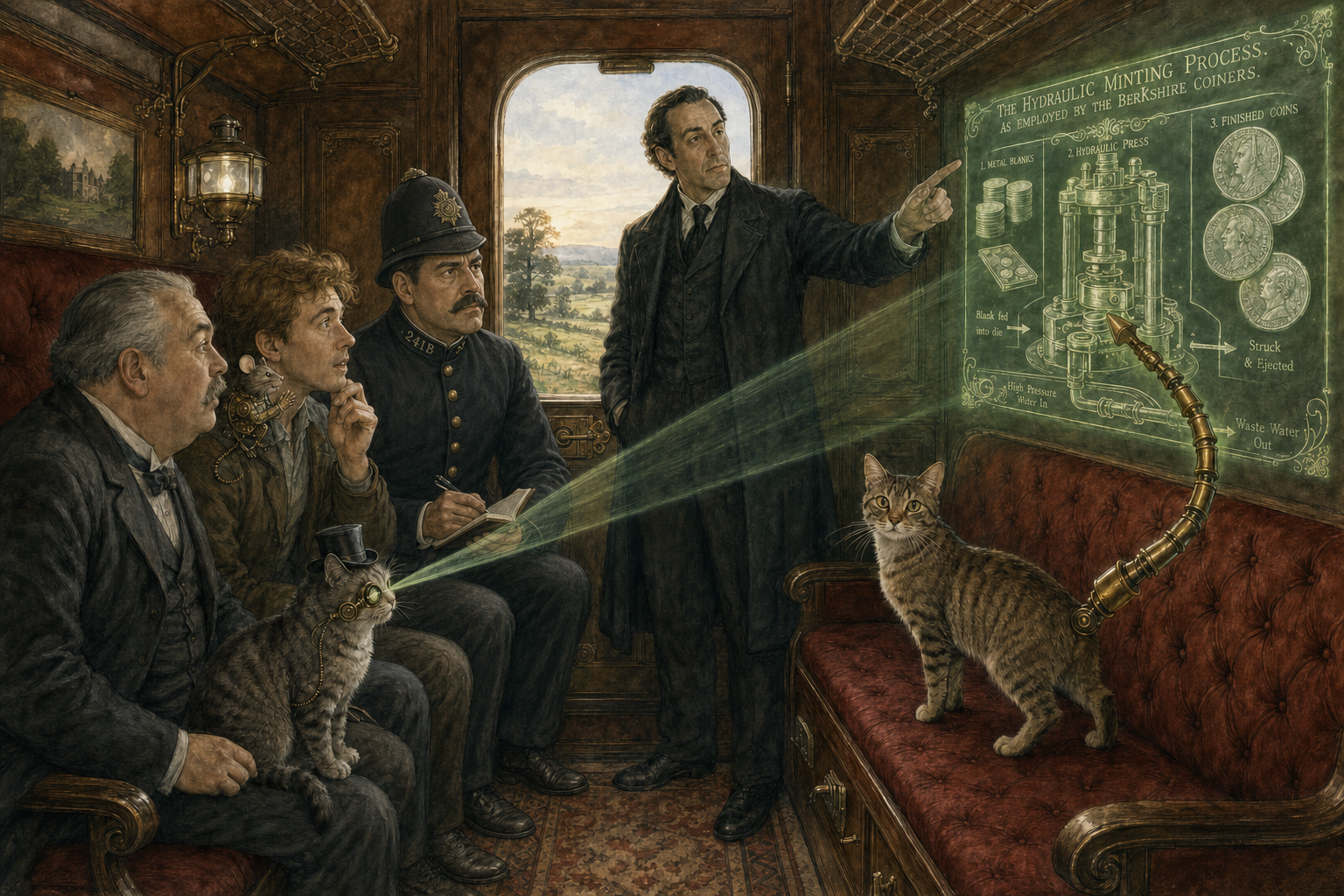
Scene: The train rattles through the Berkshire countryside. Inside the compartment, Holmes stands addressing the room. Hatherley, Watson, and Bradstreet are seated or leaning forward, all eyes on the compartment wall where a faintly glowing Victorian infographic is projected by Catticus Finch’s diffracted monocle cone from beneath the seat.
The infographic is rendered in delicate green laser light, etched in a quaintly Victorian style: a diagram showing the coining process from raw metal blanks through the hydraulic press to finished counterfeit half-crowns. The style is technical illustration — engraving lines, labelled components, cross-sections — as though drawn by a Victorian engineer, but luminous and green, projected on the wooden compartment wall.
Catticus is barely visible beneath the seat, his body hidden in shadow. system fanning a diffracted cone of green light upward onto the wall. The Only his head, top hat and brass monocle array is clearly seen — the multi-lens projection humans see the diagram but not the cat.
Lollipop, curls her way between Holmes' legs in classic cat fashion, extending her segmented brass scorpion tail upward. The stinger tip traces the path of the process through the diagram — lingering on the press mechanism and the finished coins — like a teacher guiding her audience’s attention to the right part of the infographic.
Tick-Tock sits on Hatherley’s shoulder, clapping, delightedly, leaning forward with wide eyes, fascinated by the glowing diagram. The humans stare at the wall, captivated — none of them aware that the projection is coming from beneath the seat.
Narration:
"None at all," said Holmes. "They are coiners on a large scale, and have used the machine to form the amalgam which has taken the place of silver."
"We have known for some time that a clever gang was at work," said the inspector. "They have been turning out half-crowns by the thousand."
Holmes gestured toward the wall, where a luminous diagram traced the path from blank metal to counterfeit coin. None of us thought to ask how it had got there.
Cat note: Catticus’s projection system is the same multi-lens monocle array used for the map deduction. The diffracted cone of green light is broader than a single beam — it illuminates a section of the compartment wall like a soft spotlight. The infographic style is deliberately antiquated: engraving-line cross-sections, hand-lettered labels, Victorian technical illustration rendered in green laser light. Lollipop’s scorpion tail is in full extension from the luggage rack, the brass segments telescoped, the stinger used precisely as a pointer.
Mouse Note: Tick-Tock is perched on Hatherley’s shoulder, leaning forward,clapping with innocent delight, staring at the infographic with wide, fascinated eyes. He chitters softly at the diagram.
15. Spread 16 — Smoke Above Eyford
Pages 36–37 — Double-page spread
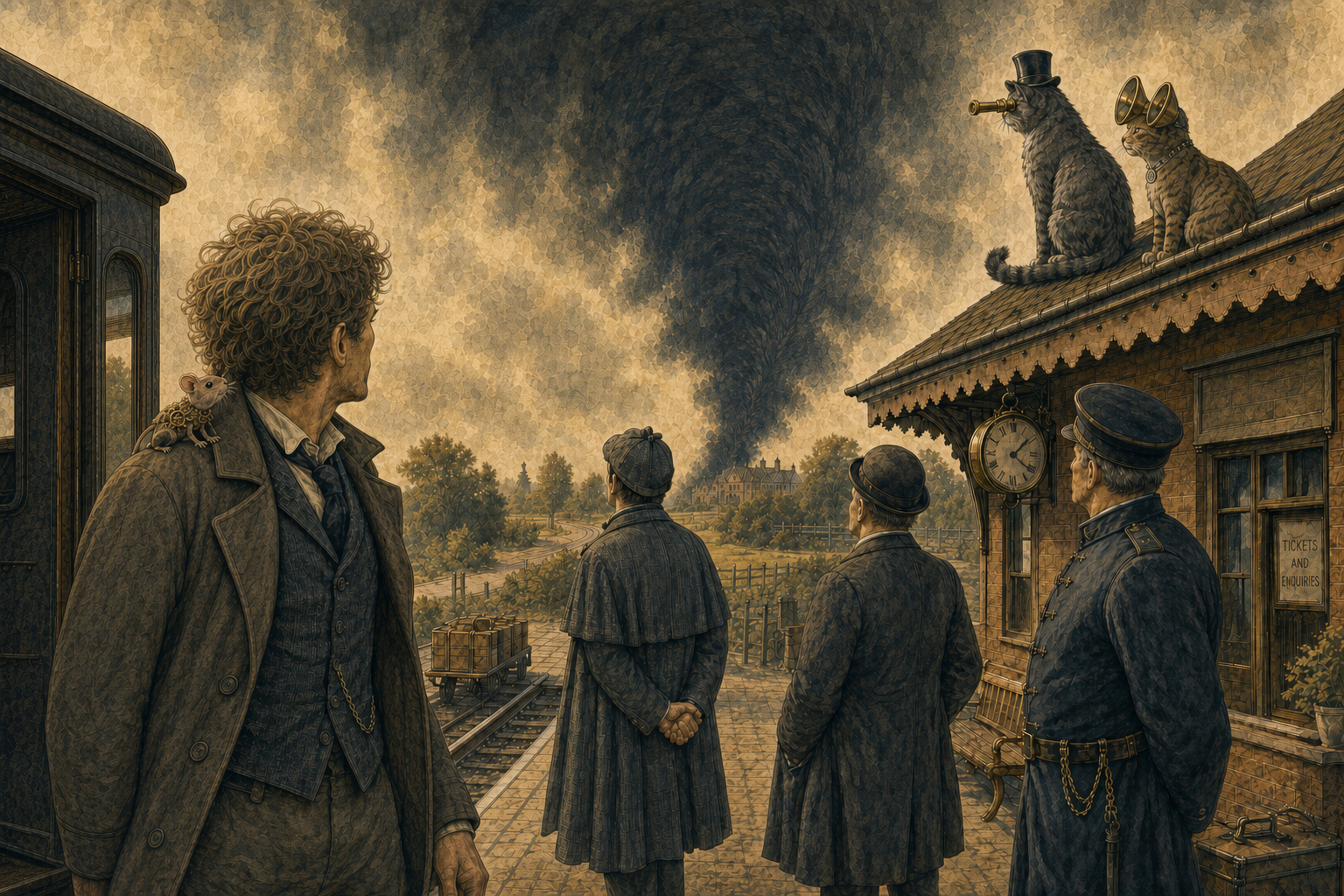
Scene: Eyford station platform. The train has just arrived. The party steps onto the platform — and freezes. A gigantic column of smoke rises above the trees beyond the village, hanging like an immense ostrich feather over the landscape. The house is burning.
Narration:
As we rolled into Eyford Station we saw a gigantic column of smoke which streamed up from behind a small clump of trees in the neighbourhood and hung like an immense ostrich feather over the landscape.
"A house on fire?" asked Bradstreet as the train steamed off again on its way.
Cat note: Just above the men, on the roof of the Eyford station house, Catticus and Lollopop watch the smoke. Catticus monocled eye has one again transformed into an ornate, brass telescope which he uses to survey the burning house, from a distance. Lollopops ears are again transformed into parabolic reflectors as she trains them in the direction of the house to hear anything that may inform the situation further.
Mouse Note: Tick-Tock peers out of Hatherley’s pocket at the smoke, ears flat, his mouth a silent, "O" of alarms and his tiny paws on each cheek.
16. Spread 17 — The Smouldering Ruins
Pages 38–39 — Double-page spread
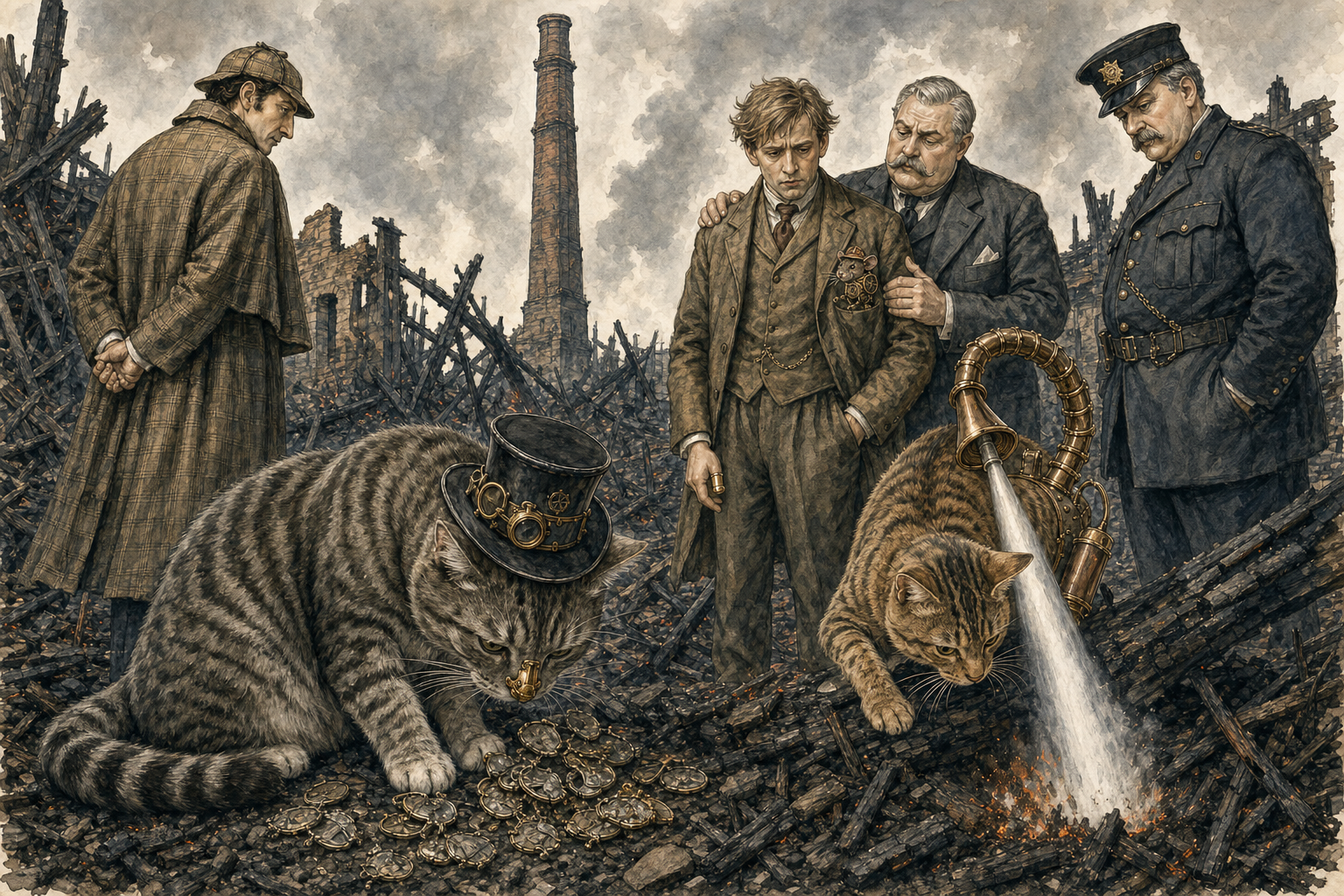
Scene: The party has driven from the station to the site of the house. What remains is a blackened shell — smouldering timbers, a few licks of flame, collapsed walls, a chimney stack standing alone against a grey sky. The criminals have fled. The evidence is ash.
Holmes stands at the edge of the ruins, hands behind his back, studying the remains. Hatherley stares at the place where he nearly died. Bradstreet surveys the destruction with professional frustration. Watson stands beside Hatherley, one hand on his shoulder.
Narration:
"You have had your revenge," said Holmes.
But the criminals were gone.
"I have lost my thumb and my fee. What have I gained?" asked Hatherley.
"Experience," said Holmes.
Cat note: Catticus is amongst the ruins. His steampumk brass nose as returned and its heightened olfactory senses have lead him to a small pile of half melted, counterfeit coins. He sniffs at them tentatively. His top hat is on his head and his monocle glints, in his right eye.
Lollipop’s ears have returned to normal however, the end of her scorpion tail has transformed into the cone of a fire-extinguisher from the end of which a jet of CO2 extinguishes one of isolated fires still burning amongst the wreckage.
Mouse Note: Tick-Tock, has returned in Hatherley’s pocket but has donned a fireman’s hat.
17. Back Matter
Page 36
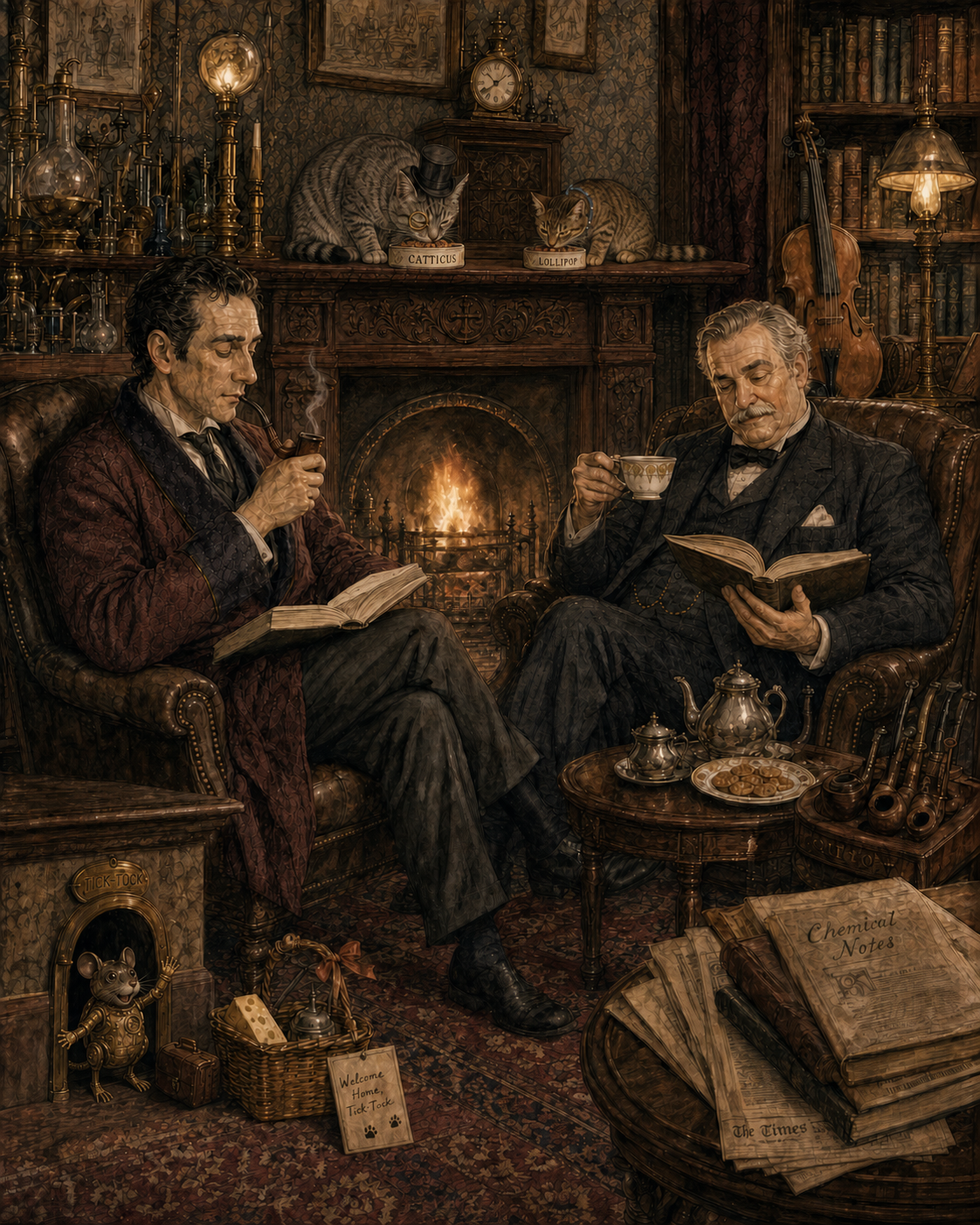
Scene: The sitting room at 221B Baker Street. Evening. Holmes reads by the fire. On the mantelpiece, Catticus Finch and Lollipop sit in the warm glow, eating a salmon treat form bowls with their names on them. We see that down by the skirting board a new mousehole has been created and an small, ornate, brass and copper arch proclaims that it is Tick-Tock’s. We see a mousesized house-warming basket with a wedge of cheese and an oil can dressed with bows and a note saying "Welcome Home, Tick-tock" sighed with two paw prints. Tick-tock stands in the entrance with a little suitcase, clearly moving in and waving to his new family with unfeigned joy on his face.